Why laundries fail, and why delivery start-ups failed
Why do laundries fail?
Laundries rarely fail because of the washing. They fail when they grow before one order makes a profit, when they depend on a plant they do not control, or when the cash runs out before customers come back. Well-funded delivery start-ups such as Washio, Prim and Laundrapp closed for those reasons.
Laundries rarely fail because of the washing. They fail when they grow before one order makes a profit, when they depend on a plant they do not control, or when the cash runs out before customers come back. Well-funded delivery start-ups such as Washio, Prim and Laundrapp closed for those reasons, while the survivors grew slowly, bought customers cheaply or controlled their own plant.
I am Talal Junaid. I run a pickup-and-delivery laundry in Barcelona, and I built LaundryFuture from what we use ourselves. This page uses public cases, with a link to each source, and one lesson from our own laundry. Learn from someone who already did it — don't learn by mistakes that cost you money.
How often do laundries fail?
Nobody publishes a reliable failure rate. You will read online that about 95 percent of laundromats succeed, but the pages that say it (Laundromat Resource, BizBen, both read 20 Nov 2026) are blogs and business brokers, and none shows a method. We could not find a trade body that publishes a failure rate. So do not plan on a percentage. Plan on the causes below, which repeat in every case we could check.
Why do self-service laundromats fail?
For a walk-in laundromat, the trade press keeps naming the same causes:
- Location. A column in the trade magazine American Coin-Op lists location among the main reasons a store fails, and calls neglect by the owner the most preventable one (American Coin-Op, read 20 Nov 2026).
- Maintenance put off. Machines that are not serviced break down, and a broken machine earns nothing.
- One large, unexpected cost. Laundromat Resource (read 20 Nov 2026) names an expense the business cannot cover, and a falling local population, as ways a store goes under.
None of these is about the wash cycle. They are about the site, the cash buffer and the owner's attention.
Why did laundry delivery start-ups fail?
Pickup-and-delivery laundry adds two costs a walk-in store does not have: the driver and the plant. The public record shows how the start-ups lost money on them.
| Company | What happened | Source |
|---|---|---|
| Washio (US) | Raised $16.82M, stopped taking orders in late August 2016 | TechCrunch |
| Prim (US) | Closed on 10 January 2014 after seven months; washing was done by laundromats on a verbal deal | Fortune |
| Laundrapp (UK) | Raised over £15M, went into administration in February 2020; assets reportedly sold for under £1M | Business Sale |
| FlyCleaners (US) | Closed its New York plant in 2019 and moved much of its business to a competitor | TechCrunch, The Hustle |
| Loopie (US) | Sold its wash-and-fold business in 2024; Rinse took Seattle | GeekWire |
All sources read 19 or 20 Nov 2026.
Washio: growing city by city before the order paid
Washio raised $16.82M and stopped taking orders in late August 2016. Press reports at the time pointed to low margins that need fast expansion, and fierce competition from Rinse, FlyCleaners and others. TechCrunch reported that it had tried to sell itself to competitors without success. Its customers went to Rinse.
The lesson. More cities multiply the result of one city. If one order loses money, ten cities lose ten times as much.
Prim: competing against your own supplier
Prim washed about 1,000 lb a day for about 40 customers a day, but it did not own a plant. It sent the washing to laundromats on a verbal discount, and the laundromats came to see it as a competitor. Fortune reported that its own plants would have cost hundreds of thousands of dollars per city. It closed after seven months.
The lesson. A partner plant is a fine way to start, but only with written terms and a second partner ready.
Laundrapp: cash ran out before the model worked
Laundrapp in the UK raised over £15M. When the cash ran out and shareholders declined to put in more, it went into administration in February 2020, and its assets were reportedly sold for under £1M. In 2019 it had merged with Zipjet. Laundryheap bought the Laundrapp business in 2022.
The lesson. Money raised buys time, not a working model. If repeat orders and profit per order are not there, more money only makes the loss bigger.
FlyCleaners and Loopie: quality and profit you do not control
FlyCleaners in New York spread work across more than a dozen vendors and had quality problems. In 2019 it closed its Long Island City plant to become "more asset-light" and moved much of its business to a competitor. Loopie, a peer-to-peer laundry in Seattle, sold its wash-and-fold business in 2024; its founder said profit was hard to keep and the next funding round did not come.
The lesson. If someone else washes, your brand carries their quality. Measure it on every order.
What did the survivors do differently?
The companies still standing did one of two things.
- They grew slowly and bought customers cheaply. Rinse took over Washio's and Loopie's customers instead of paying to find every one, and in February 2025 it announced a $23M Series D led by LG Electronics (read 20 Nov 2026). Laundryheap ran for three years before raising £2M in 2017, then bought Laundrapp.
- They controlled the plant. Washmen in Dubai opened its own plant in June 2019 and moved away from depending on partner laundries.
This pattern is our reading of the cases above, not a study.
What we learned at HolaWash We gave every delivery zone the same time slots and the same fees. Outside the city, a small share of our stops took a much larger share of our driver-hours. What we would do instead: draw the zones on a map, serve the outer zone in two or three fixed windows a week, and add a surcharge. It is the Washio lesson at the size of one laundry: find the zone that loses money before you add more of it.
How do you stop your laundry from failing?
Use this checklist before you open, launch delivery or expand:
- Profit per order, in one zone. After washing, packing and delivery, is one order positive? Open a second zone only when it stays positive.
- Profit per stop. Do you know which zones take the most driver time per order? Price or limit those zones.
- A written deal for every plant. Price per kg, turnaround, quality standard, what happens when they are full, how either side leaves, and a second partner on standby.
- A cash buffer. Can you cover a broken machine or a slow quarter without new money?
- Repeat orders measured. What share of first-time customers order again within 30 days?
- One place for the numbers. Orders, customers, stops and quality issues in one system, so you see a loss in a week, not a year.
If your current laundry software cannot show you profit per zone or repeat orders, that is a reason to look at a replacement such as LaundryFuture.
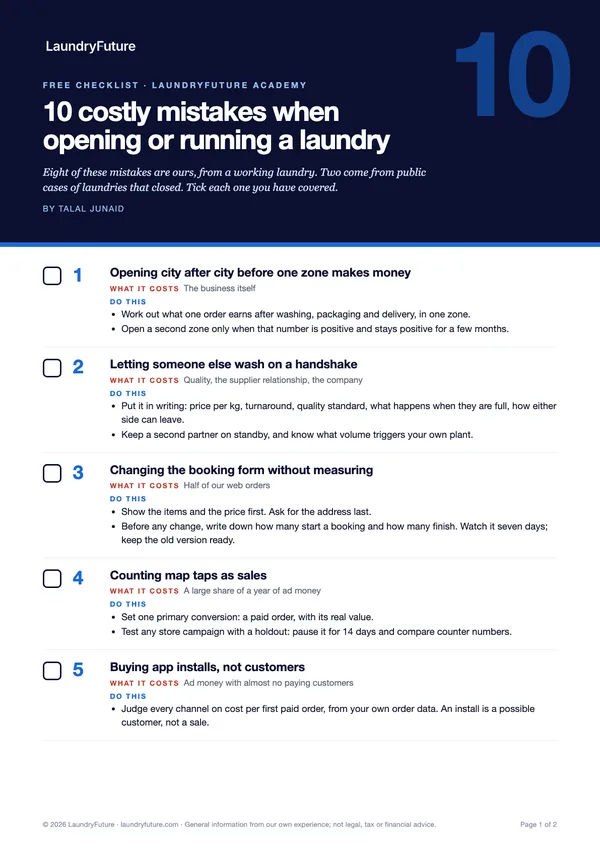
Free checklist
10 costly mistakes when opening or running a laundry
Two pages from Talal: the ten mistakes that cost laundry owners money, what each one costs and what to do instead. Tick them off before you spend.
- Ten mistakes, from opening too fast to counting map taps as sales
- What each one costs, and the fix in one line
- Five checks before you spend money
FAQ
Why do most laundromats fail?
The causes named most often are a poor location, maintenance put off, and one large cost the business cannot cover. Owner neglect is the most preventable. There is no reliable published failure rate, so judge your own site, cash buffer and machines rather than an industry percentage.
Why did Washio fail?
Washio raised $16.82M and closed in August 2016. Press reports pointed to low margins that needed fast growth, strong competition and a sale to a competitor that did not happen. Its customers went to Rinse.
Is a laundry delivery business a bad idea?
No, but the public record is mixed. Several well-funded delivery start-ups closed, while Rinse, Laundryheap and Washmen are still growing. The difference is profit per order and per stop, control of the plant, and repeat customers. Measure those before you scale.
Should I outsource washing to another laundry?
You can start that way. Prim shows what happens on a handshake: the partner became a competitor. Put the price, turnaround and quality standard in writing, keep a second partner, and decide in advance what volume makes your own plant worth it.
What is the first number I should track?
Profit per order after washing, packing and delivery, in one zone. Then repeat orders within 30 days. If both are positive, growth multiplies a profit instead of a loss.
What should you do next?
Read the 10 mistakes laundry owners make that cost money from day one for the smaller, daily ones. The full method for zones, plants and delivery costs is in the Academy book on pickup and delivery. If you want to talk through your own plan, or see how LaundryFuture replaces your current laundry software, book a 20-minute call with me.
Learn from someone who already did it — don't learn by mistakes that cost you money. The answers are here, from Talal.
Sources
- TechCrunch: Washio shuts down (read 20 Nov 2026)
- Quartz: Washio, the symbol of the Uber-for-X bubble (fact file, 17 Nov 2026)
- Fortune: Prim, anatomy of a folded start-up (read 19 Nov 2026)
- Business Sale: Laundrapp after administration (read 19 Nov 2026)
- Global Venturing: Laundrapp and Zipjet merger (fact file, 17 Nov 2026)
- Tech.eu: Laundryheap buys Laundrapp (fact file, 17 Nov 2026)
- TechCrunch: FlyCleaners layoffs, 2019 (read 20 Nov 2026)
- The Hustle: FlyCleaners (read 20 Nov 2026)
- GeekWire: Loopie sells part of its business (read 20 Nov 2026)
- Crunchbase News: Rinse (fact file, 17 Nov 2026)
- Rinse: Series D announcement (read 20 Nov 2026)
- TechCrunch: Laundryheap (fact file, 17 Nov 2026)
- Wamda: Washmen raises $6.2M (read 19 Nov 2026)
- American Coin-Op: the top 5 reasons for success and failure (read 20 Nov 2026)
- Laundromat Resource: what to do if your laundromat is failing (read 20 Nov 2026)
- BizBen: why do laundromats fail? (read 20 Nov 2026)
- Free sampleThe foreword and two full chapters of the book, by e-mail.
- The book · €29How to Open a Laundry in 2027: And the plant behind it: model, premises, budget, machines, energy, chemicals, suppliers, staff, pricing and break-even for a laundry, dry cleaner or laundromat.
- Book a 20-min call20 minutes with Talal, with the system running live.
Related articles
- 6 min read
How much does a laundry really make? Revenue is not profit
What a laundromat or laundry really makes a year: revenue, cash flow and margin from industry sources, and how to work out your own profit per order.
- 6 min read
How to start a laundry business from home: a realistic plan
How to start a laundry business from home: wash and fold or pickup and delivery, what to check first, pricing, your first customers, and when to move out.
- 12 min read
10 mistakes laundry owners make that cost money from day one
Ten costly mistakes in new laundries, from expanding too fast to counting map taps as sales. What each costs, and how to avoid it, from a working owner.